
The Non-Citizen National Passport Application Process: How to Travel Without Federal Strings
- Jul 7
- 14 min read
For most people, the passport application process seems like just another routine bureaucratic hurdle—fill out the form, pay the fee, and get your ticket to travel. However, nearly everyone unknowingly makes a critical mistake right at the start: they blindly check the "U.S. Citizen" box. Few realize that this simple checkmark is a contract that voluntarily places them under federal jurisdiction, subjecting them to statutes and regulations that may not actually apply to them by birthright. There is a "hidden" choice available, one that acknowledges your status not as a corporate subject, but as a free individual.
This alternative status is defined in federal law under 8 U.S.C. § 1101(a)(22)(B). It describes a "national of the United States" as someone who owes permanent allegiance to the United States but is not a citizen of the federal corporation. This distinction is vital for those seeking to reclaim their sovereignty. By identifying as a Non-Citizen National, you are declaring that you are part of the constitutional Republic—born on the land of one of the several States—rather than a subject of the federal "United States" zone (like D.C. or territories).
The goal of this guide is to help you navigate the passport application process with eyes wide open. We aren't just looking to get a travel booklet; we are looking to obtain a document that accurately reflects your private status as a State National. Securing a passport with the correct designation is one of the most powerful ways to solidify your standing, ensuring that your right to travel is respected without attaching the federal "strings" that come with standard citizenship.

Identifying the "Strings": Why Status Matters for Travel
When you hold a standard passport, you are holding more than just a travel document; you are holding a contract. This section explains why the specific status you claim on your passport application process matters immensely. It creates the legal framework for how the government interacts with you—either as a subject they can regulate or a national with inherent rights.
Contracts and Presumptions
The moment you check the box for "U.S. Citizen" on a standard government form, you are effectively signing a confession of judgment. You are agreeing to be treated as a statutory creation—a "person" subject to the full scope of federal statutes, codes, and regulations.
Legally, this creates a presumption of jurisdiction. By identifying as a "U.S. Citizen," you are signaling to the Department of State (and by extension, foreign governments) that you are property of the federal corporation. This presumption allows the government to attach "strings" to your movement, such as the ability to revoke your passport for unpaid taxes or other statutory infractions. When you apply as a Non-Citizen National, you are rebutting this presumption. You are stating that while you owe allegiance to the republic, you are not subject to the internal by-laws of the corporate state.
The 14th Amendment Connection
To understand why this distinction exists, we must look at the 14th Amendment. As discussed in our previous articles on the Federal Franchise, the 14th Amendment created a new class of citizenship: the "federal citizen."
State Citizens (Pre-14th Amendment): The original citizenry of the organic Republic. Their rights are God-given and protected by the Constitution.
U.S. Citizens (14th Amendment): A privilege granted by the federal government. Their "rights" are actually civil privileges that can be granted, regulated, or taken away.
When you apply for a passport as a U.S. Citizen, you are willingly stepping into that second category. You are accepting the "benefit" of federal protection in exchange for the "burden" of total federal compliance. Correcting your status removes you from this jurisdiction of "privileges" and restores you to the jurisdiction of rights.
Benefits of the Non-Citizen National Passport Application Process
Shifting your status changes the nature of your travel from a permission-based activity to a protected right. Below is a comparison of how these two statuses function in practice:
Feature | Standard "U.S. Citizen" Passport | Non-Citizen National Passport |
Nature of Travel | Privilege: Can be suspended or revoked for statutory infractions (e.g., child support, taxes). | Right: Based on inherent freedom of movement; much harder for the state to lawfully restrict. |
Jurisdiction | Federal Subject: You are under the direct authority of Washington D.C. and its agencies. | Private Capacity: You are a National of the Republic, operating outside the "federal zone." |
Diplomatic Standing | None: You are essentially a piece of inventory belonging to the U.S. corporation. | Diplomatic Nuances: While not a foreign ambassador, you carry a status closer to a diplomat—a sovereign visiting a foreign jurisdiction, entitled to protection but not automatic subjection. |
Tax Implications | Worldwide Taxation: Liable for taxes on income earned anywhere in the world. | Foreign Status: Often establishes a basis for being a "non-resident alien" regarding the IRS (depending on other factors). |
By navigating the application process correctly, you are not just getting a book to cross borders; you are carrying physical evidence that you have unraveled the strings of the strawman. You must have a detailed knowledge of the rights of non-citizens in the United States.
Pre-Application: The Documentation Foundation
Before you even download the DS-11 form, you must lay the groundwork. The passport application process is not the first step in reclaiming your freedom; it is the final step of the administrative process. Attempting to apply for a Non-Citizen National passport without first correcting your status in the public record is like trying to withdraw money from a bank account you haven't opened yet.
Status Correction First: The AOR Package
Your passport does not create your status; it merely reflects the status you have already established. If your records with the vital statistics office and the federal government still categorize you as a standard "U.S. Citizen," your application for a different status may be rejected or ignored.
This is why the Acceptance of Responsibility (AOR) package is critical. The AOR is a comprehensive set of affidavits and notices that rebut the presumption of federal corporate citizenship. It places evidence on the record that you have:
Revoked your power of attorney with the state.
Accepted the deed to your own body and property.
Declared your standing as a State National.
Scholars of American jurisprudence have long noted that citizenship is a consensual relationship. As discussed in legal reviews regarding the Expatriation Act of 1868, the right of an individual to define their political allegiance is a fundamental human right. Without the AOR, you lack the evidence to prove you have withdrawn your consent to the federal franchise.
Evidence of Nationality
The most important document in the passport application process is your Birth Certificate—but not for the reasons most people think. For a State National, the birth certificate is evidence of jus soli (right of the soil) within the Republic, not the federal zone.
The Republic: The 50 sovereign states (e.g., Texas, Florida, Nevada).
The Federal Zone: The District of Columbia, Puerto Rico, Guam, etc.
When you submit your birth certificate, you are proving that you were born on the land of a sovereign state. According to 8 U.S.C. § 1408, it is possible to be a national of the United States without being a citizen. Your birth certificate is the primary evidence that you fall under the jurisdiction of the organic Constitution rather than the legislative democracy of Washington D.C.

The "Notice of Status"
When you mail your application, you cannot simply rely on the checkbox. You must include a "Notice of Status" or an "Explanatory Statement." This is a supplemental document (often an affidavit) that clearly defines why you are choosing "Non-Citizen National."
This document should cite relevant statutes to force the passport agency to adjudicate your application based on law, not policy.
Reference: 8 U.S.C. § 1101(a)(21) defines "national" as a person owing permanent allegiance to a state.
Reference: 8 U.S.C. § 1101(a)(22) distinguishes between a "citizen of the United States" and a "national of the United States."
By attaching this notice, you create a paper trail. If the agency denies your status, they must do so in writing, which effectively admits they are ignoring their own statutes. This strategic layer of documentation transforms a standard application into an enforcement of your rights.
Step-by-Step: The DS-11 Passport Application Process
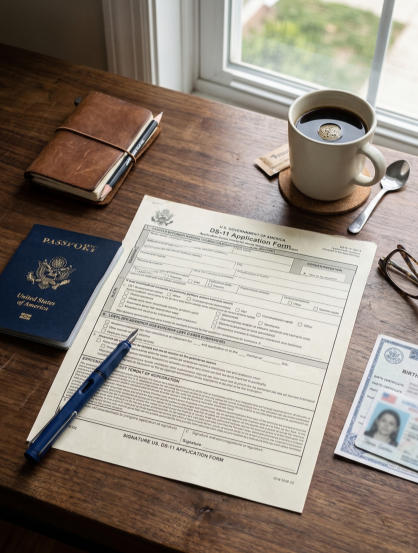
This is where the rubber meets the road. The DS-11 form is designed for the standard federal citizen, so navigating it as a State National requires precision. Every box you check and every line you fill out is a legal statement. To ensure your passport application process results in the correct status, you must avoid the common "traps" that pull you back into federal jurisdiction.
Section-by-Section Guide: avoiding the "Traps"
The standard DS-11 form is a contract of adhesion—a standard form contract where one party (the government) sets the terms. However, you have the right to modify or clarify your agreement.
Name: Use proper capitalization (e.g., John Doe) rather than ALL CAPS (JOHN DOE) if possible, as ALL CAPS often denotes the corporate "strawman" entity.
Place of Birth: Be specific. Instead of just writing "TX" or "USA," many Non-Citizen Nationals write "Texas Republic" or "United States of America (Republic)" to distinguish the organic land from the federal corporation.
Occupation: Avoid terms that imply a statutory employee status. Use "Private" or "Non-Commercial" if applicable to your situation.
Checking the Correct Box: The "Citizenship" Question
The most critical part of the passport application process is the citizenship declaration. On the standard DS-11, the form often conflates the two statuses with a statement like: "I declare that I am a citizen or non-citizen national of the United States."
Checking this box without qualification can be interpreted as admitting to being a U.S. Citizen (federal subject). The Strategic Approach:
The Asterisk Method: Many State Nationals check the box but place a distinct asterisk (*) next to it.
The Annotation: Somewhere clearly on the form (often in the margin or near the signature block), write: "See Attached Affidavit of Status."
The Explanatory Statement: You are explicitly stating that you are checking the box only as a "Non-Citizen National" as defined in 8 U.S.C. § 1101(a)(21), and not as a "U.S. Citizen" defined in the 14th Amendment.
Mailing Address vs. Permanent Residence
Federal jurisdiction is often tied to "residency." A "resident" is legally someone who has established a domicile within the jurisdiction of the state.
Avoid "Permanent Address": If the form asks for a "Permanent Address," realize that "permanent" implies domicile.
Use "In Care Of" (c/o): When filling out the mailing address, use the "c/o" prefix. For example: c/o John Doe. This indicates that you are receiving mail at that location but are not necessarily the liable resident entity attached to that property.
General Delivery: For maximum privacy, some choose to use "General Delivery" at a local post office. This removes your physical location from the federal database entirely during the passport application process.
The Social Security Number (SSN) Dilemma
The requirement to provide a Social Security Number is a significant hurdle for those reclaiming sovereignty. The SSN is the primary tracking number for federal citizens.
The Lawful Approach (26 CFR 301.6109-1): According to 26 CFR 301.6109-1, the requirement to furnish a taxpayer identification number generally applies to "U.S. persons" engaging in taxable activities.
If you have revoked your SSN: If you have gone through the process of revocation or are claiming you are not a "U.S. person" under tax law, you cannot truthfully provide an SSN.
The Affidavit of No Number: In this case, you would enter zeros (000-00-0000) in the SSN field. You must then attach a sworn affidavit stating that you are a Non-Citizen National and are not a "U.S. person" required to have or use a Social Security Number for this purpose.
Executing the Filing: At the Acceptance Agency
You have prepared your documents, your affidavits are notarized, and your passport application process is nearly complete. Now comes the physical interaction: the Acceptance Agent. This step can be intimidating, as you are bringing non-standard documentation into a highly standardized bureaucratic environment. Success here depends on preparation, demeanor, and knowing your rights.
Choosing the Right Facility
Not all acceptance facilities are created equal. While most people default to the local Post Office, these locations are often staffed by busy postal workers who are trained to reject anything that doesn't look exactly like the "template." They are often rushed and less willing to deal with the nuances of a Non-Citizen National application.
Better Alternatives:
County Clerk of Court: These officials are often more familiar with legal affidavits and non-standard filings. They tend to be more patient and knowledgeable about the difference between a "statutory employee" and a "private citizen."
Public Libraries: Many libraries act as acceptance agents. The atmosphere is generally calmer, and the staff may be more accommodating.
By Appointment Only: Regardless of the facility, book an appointment. Walking in during a rush increases the likelihood of a clerk rejecting your application simply to clear the line.
The "Do Not Sign" Rule
There is one golden rule in the passport application process: Do not sign the DS-11 until you are in front of the agent. If you sign it beforehand, the document is void, and you will have to start over.
The Signature Strategy (U.C.C. 1-308): When the agent tells you to sign, you are entering a contract. To protect your rights and prevent the government from assuming you are waiving your sovereignty, many State Nationals use a specific signature format.
"All Rights Reserved": You may sign your name followed by "All Rights Reserved" or "Without Prejudice" (referencing U.C.C. 1-308).
"Under Duress": If the clerk forces you to agree to a statement you disagree with (like the standard citizenship clause), you can sign "Under Duress."
Legal Note: U.C.C. 1-308 (Performance or Acceptance Under Reservation of Rights) states that a party who performs or promises performance explicitly reserving rights does not thereby prejudice the rights reserved. This prevents your signature from being interpreted as a voluntary surrender of your status.
Handling the Clerk
The acceptance agent is not an adjudicator. Their job is strictly limited to:
Verifying your identity.
Witnessing your signature.
Collecting the fee.
If the Clerk is Confused:
Stay Calm: Do not get angry or start quoting Black's Law Dictionary.
The "Mail It Anyway" Approach: If the clerk says, "You can't put zeros for the SSN," or "You can't attach this affidavit," calmly reply: "I understand your concern, but please process the application as is. The Department of State in Washington D.C. will make the final decision, not this office."
Refer to the Manual: If they refuse, you can politely ask them to check the Foreign Affairs Manual (7 FAM 1100) regarding "passports for non-citizen nationals."
Remember, you are the customer. You are paying for a service. Your confidence and politeness will usually get the application into the mailbag, which is the only goal of this visit.
What to Expect: The "Endorsement"
After navigating the complexities of the passport application process, the waiting game begins. When the blue book finally arrives in your mailbox, it may look identical to any standard passport on the outside. However, for a Non-Citizen National, the true power lies not in the cover, but in the pages within. This section explains how to verify that your status correction has been recognized by the Department of State.

The Five-Star Endorsement
There is a common misconception that a Non-Citizen National passport will have a different color (like black or red) or distinct stars on the cover. In reality, the physical book issued to State Nationals is the standard blue tourist passport. The difference—the "Five-Star" quality—is hidden in the endorsements section on the back pages (usually page 24 or similar).
If your application was successful and your status as a "national but not a citizen" was adjudicated correctly, you will find a specific annotation printed on these pages. This is not a mistake; it is the Department of State explicitly acknowledging your standing under international law.
Endorsement Code 09
The specific language you are looking for is known internally as Endorsement Code 09. This code triggers a printed statement that overrides the standard presumption of federal citizenship.
The Golden Text:
"The bearer is a United States National and not a United States Citizen."
This single sentence is the "magic" that separates you from the federal jurisdiction.
Legal Meaning: It confirms you are a national under 8 U.S.C. § 1101(a)(21).
Practical Effect: It serves as prima facie evidence that you are not subject to the privileges and immunities clause of the 14th Amendment in the same way a federal citizen is. You have the protection of the U.S. government abroad without being "owned" by the U.S. corporation at home.
Verification: How to Check Your Status
Once the book arrives, verify immediately.
Open to the Endorsements: Flip to the back pages. If the page is blank, your application was processed as a standard "U.S. Citizen" passport. This means your affidavit was likely ignored or separated from the application.
Request Your File: If the endorsement is missing, you must not use the passport if you intend to stand on your rights. You should file a Privacy Act Request or a Freedom of Information Act (FOIA) request for your passport file. This will allow you to see the internal notes and determine why the endorsement was omitted.
The "A-File": For those deeply involved in the process, checking your "A-File" (Alien File, though often used for status issues) or Department of State records can confirm if your status has been updated in the federal database, regardless of what is printed in the book.
Obtaining the Code 09 endorsement is the ultimate validation of a successful passport application process, proving you have successfully navigated the system to reclaim your private rights.
Traveling in the Private: Using Your New Document
Completing the passport application process and receiving your book is a victory, but it is only the beginning. The true test of your status is how you use this document in the real world. A Non-Citizen National passport is a powerful tool, but it requires a specific mindset and behavioral shift to be effective. You are no longer asking for permission; you are exercising a right to travel.
Border Crossings: Carrying Yourself as a State National
When you present your passport at a border, you are interacting with federal agents who are trained to deal with subjects, not nationals. Your demeanor must reflect your status.
Be Polite but Firm: You are a national returning to your country, not a subject begging for entry. Answer questions directly but briefly. Do not volunteer extra information.
Declare Your Status: If asked about your citizenship, reply clearly: "I am a National of the United States." This aligns with the endorsement in your book (if you successfully received Code 09).
Avoid "U.S. Citizen" Lanes: While often unavoidable due to logistics, mentally and verbally maintain that you are entering by right of soil, not by permission of the corporate state.
Administrative Interactions: The Passport as Primary ID
One of the most strategic uses of your new passport happens far away from any border—right in your local town. The standard driver's license is a commercial contract that subjects you to the motor vehicle code of the state corporation. By contrast, your passport is a superior form of identification that carries no such commercial implication.
Stop "Volunteering" for Jurisdiction:
Traffic Stops: If stopped while traveling (driving), presenting a driver's license immediately grants jurisdiction. Presenting your passport serves as valid identification without admitting you are operating in commerce.
Buying Property or Banking: Use your passport for all identification needs. This prevents you from connecting your private property to a state-issued "privileged" ID number.
TSA and Domestic Flights: Your passport is the "Gold Standard" for Real ID. Using it for domestic flights reinforces your status as a national traveling freely, rather than a state citizen subject to local statutes.
The "Private" Mindset
The shift from "U.S. Citizen" to "State National" is 10% paperwork and 90% mindset. The passport application process was the paperwork; now comes the mental shift.
From Permission to Right: A citizen asks, "May I?" A national states, "I am."
From Privilege to Property: A driver's license is the state's property on loan to you. Your passport, while technically government property, represents your inherent political status.
From Fear to Freedom: When you understand that you are not a surety for the national debt or a subject of the District of Columbia, you travel with a confidence that no mere administrative code can shake.
Your passport is the physical manifestation of this freedom. Carry it not just as travel insurance, but as your shield against the encroachments of the corporate state.
Conclusion: Reclaiming Your Freedom of Movement
The passport application process is often viewed as a mundane administrative task—a checkbox to tick before a vacation. But for the awakening State National, it is a profound declaration of intent. It is the moment you stop acquiescing to a system of implied contracts and start asserting your standing as a free man or woman on the land. By securing a passport that reflects your true status, you are not just obtaining a travel document; you are holding physical proof that you operate outside the jurisdiction of the federal corporation.
Taking control of your documentation is the final, decisive step in the "unraveling" process. You have educated yourself, corrected your status on the public record, and now, you have the identification to back it up. Whether you are crossing international borders or simply navigating your daily life, this passport serves as a shield against the presumptions of the state. Walk with your head high, knowing that your freedom of movement is not a privilege granted by a government agency, but an unalienable right you have boldly reclaimed.
Ready to Start Your Journey?
You cannot build a castle on a foundation of sand. Before you apply for your passport, you must ensure your status is corrected properly on the public record. Without the proper "Status Correction" evidence, your passport application is likely to be processed as just another federal citizen.
State Nationals Rock provides the exact tools and step-by-step guidance you need to lay this foundation securely: For the "Do-It-Yourself" Freedom Lover: Start with our Digital AOR Package for U.S. CITIZENS. This comprehensive digital guide gives you every affidavit, form, and instruction you need to correct your status from home at your own pace.
For the "Done-For-You" Experience: Prefer a physical kit sent to your door? The Physical AOR Package for U.S. CITIZENS includes everything printed, organized, and ready for you to execute, removing the headache of printing and formatting.


Comments