
Bouviers Law Dictionary (1856): A Look at Early American Legal Definitions
When diving into American legal history, Bouviers Law Dictionary stands out as one of the most vital and foundational reference tools ever created. First published in the 19th century, it was specifically designed to adapt legal definitions to the United States Constitution and federal laws, rather than relying solely on older English texts.
One of the biggest challenges in legal research is that everyday words often take on completely different meanings in a courtroom. Terms like "citizen," "person," or "property" can mean one thing in casual conversation and something entirely specific in a legal context.
This guide will help you understand why older legal dictionaries are so incredibly useful. Whether you are studying American law, exploring the common law, deciphering constitutional language, or researching legal history, having the right definitions makes all the difference in understanding how the system truly works.
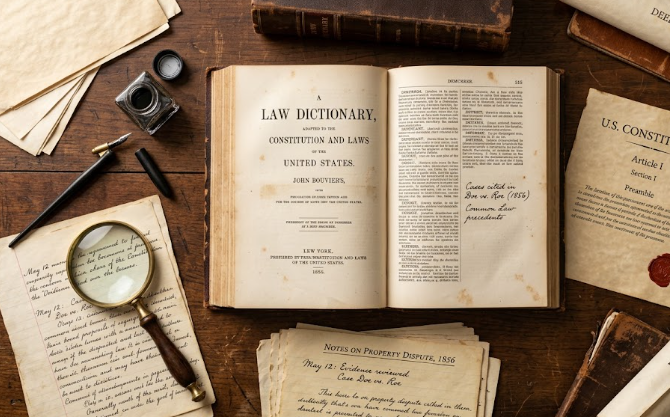
What Is Bouviers Law Dictionary?
A simple explanation
At its core, Bouviers Law Dictionary is a reference book designed specifically to define legal terms within an American legal context. Before it was created, American lawyers and judges mostly relied on English law dictionaries. However, because the United States has its own unique Constitution, federal laws, and state systems, Bouvier created a dictionary tailored specifically to the American legal landscape.
Who was John Bouvier?
John Bouvier (1787–1851) was a prominent American jurist, legal writer, and judge. Born in France, he immigrated to the United States as a child, eventually becoming a lawyer and a judge in Pennsylvania. Recognizing the massive gap in American legal literature, he dedicated years of his life to compiling, writing, and organizing definitions that accurately reflected American institutions rather than just inherited British traditions.
Why his dictionary became important
Before Bouvier’s work, professionals struggled with inconsistent definitions across different states. His dictionary became the gold standard because it bridged the gap between abstract legal theory and practical application in U.S. courts. It provided clear, reliable explanations of terms used in American legislation, court opinions, and institutional operations.
Why Legal Definitions Matter
Legal words are not always ordinary words
In everyday conversation, words are fluid. However, in the legal world, precision is everything. Many terms found in statutes and contracts carry technical definitions that differ entirely from how we use them in daily life.
Common Word | Everyday Meaning | Legal/Technical Meaning |
Person | A human being | Can include artificial entities like corporations or government bodies |
Citizen | A person who lives in a country | A specific political status granting constitutional rights and duties |
State | A condition of being, or a local government | A sovereign, independent political body |
Property | Physical items you own | The bundle of legal rights to possess, use, and dispose of an item |
Definitions shape interpretation
The definition of a single word can make or break a court case, validate or invalidate a contract, or alter the meaning of a whole statute. Judges, attorneys, and lawmakers rely on these precise definitions to interpret the intent and reach of the law.
Why older definitions can help with historical research
When reading historical documents, such as the Constitution or early state laws, you must study words in the context of the era in which they were written. Language shifts over time. Using a dictionary from the 19th century helps researchers understand what a specific phrase meant to the people who drafted and adopted it.
Why the 1856 Edition Gets Attention
Its place in American legal history
The 1856 edition of Bouvier’s Law Dictionary (often cited as A Law Dictionary, Adapted to the Constitution and Laws of the United States of America) holds a special place in legal history. Published just before the American Civil War, it perfectly captures 19th-century American legal terminology. It reflects the understanding of common law, property, and governance during a period of heavy reliance on foundational constitutional principles.
The difference between modern and older legal meanings
Language naturally evolves. A term that meant one thing in 1856 might have a completely different scope or application in a modern courtroom today. For example, concepts of "residence" versus "domicile" or the definition of "contract" have seen subtle shifts over the past two centuries. Reviewing older editions helps prevent applying modern assumptions to historical texts.
Why researchers compare editions
Serious legal researchers often compare multiple reference materials—such as Bouvier, later editions of Black’s Law Dictionary, state codes, and historical case law. Comparing these sources allows researchers to trace how a definition evolved over time, giving them a much clearer, well-rounded view of how a law was applied in the past versus how it is applied today.
Bouvier’s Dictionary and the Constitution
Legal terms used in constitutional discussions
The U.S. Constitution is built on precise legal terminology. When studying foundational law, words cannot be interpreted loosely. Bouvier’s provides clear American definitions for critical constitutional terms, such as:
Sovereignty: The supreme, absolute, and uncontrollable power by which any independent state is governed.
Jurisdiction: The legal authority of a court or government body to hear, decide, and enforce laws within a specific territory.
Citizen: An individual who, by birth or naturalization, is a member of an independent political society, owing allegiance and entitled to rights.
State: A self-governing political body, distinct from mere geographic land.
Compact: An agreement or contract between two or more parties, such as the states forming a union.
Treaty: A formal agreement negotiated and signed between sovereign nations.
Rights: Well-defined claims or freedoms that an individual is legally entitled to hold or secure.
Why constitutional words need context
To properly interpret foundational law, you must look at the original public meaning and historical legal usage. The founders and early lawmakers did not use modern, casual definitions. They wrote and debated using the established legal language of their time (heavily rooted in the common law). Relying on a 19th-century dictionary ensures you understand exactly what a term meant to the people who lived, drafted, and applied the law during that era.
How legal dictionaries support deeper study
While legal dictionaries like Bouvier’s are incredibly powerful tools for research, education, and understanding historical context, it is important to remember their limits. Dictionaries explain what words meant historically and theoretically, but they do not replace actual, active statutes, codes, or binding court rulings. They serve as a roadmap to guide your research, not as the final law itself.
Bouvier’s Dictionary and Common Law
What common law means in simple words
In simple terms, the common law is judge-made law. It is a system of long-standing legal principles, customs, and inherited traditions that come from court decisions over hundreds of years, rather than from written acts of a legislature. Brought over from England, the common law forms the very foundation of the American legal system.
Common law terms found in older dictionaries
Because early American law relied heavily on inherited traditions, Bouvier’s defines many core common law concepts. These terms have remained foundational in legal practice for centuries:
Affidavit: A written statement of facts confirmed by oath or affirmation of the party making it, taken before a person having authority to administer such an oath.
Oath: A solemn appeal to God taken as a pledge of truth, required for legal testimony and sworn documents.
Agreement where a party undertakes to do, or not do, a particular thing.
Trespass: Any unlawful physical entry or injury done to another person's property or rights.
Title: The legal right to the ownership of property, or the evidence of that right.
Property: The legal right and dominion that a person has over a specific thing, excluding others from interfering with it.
Remedy: The legal means employed to enforce a right or redress an injury.
How common law language influenced American law
The language and structure of the common law established how legal duties, contracts, and civil interactions are handled in the U.S. Understanding these historic, baseline definitions makes it much easier to comprehend how legal maxims operate in practice.
Master the Language of Common Law:
Explore the fundamentals with the FREE Common Law Guide.
Read UNRAVELING THE STRAWMAN (Softcover Book) to uncover legal fictions and proper standing.
Key Legal Terms Readers Should Research in Bouvier
Citizen
In Bouvier’s, citizen is strictly defined as a status word indicating membership in a political body. It denotes someone who possesses full civil and political rights within a specific state or nation, distinct from a mere inhabitant or resident.
Person
The legal definition of person depends heavily on context. While it naturally applies to living human beings, older legal dictionaries often note that the term can include artificial entities, such as corporations, depending on how a statute is written.
State
Bouvier differentiates between a state as a geographic location and a state as a political body. In constitutional law, a state refers to an independent, self-governing political society of people bound together by law.
United States
The phrase United States can appear in multiple legal contexts. It may refer geographically to the collective territory of the states, or politically to the federal government created by the Constitution. Researching this distinction is crucial for jurisdictional research.
Jurisdiction
Jurisdiction defines the precise boundaries of legal authority. It dictates whether a court, agency, or government body has the lawful power to hear a case, make a decision, or enforce a rule over a specific person, property, or subject matter.
Affidavit
An affidavit is simply a sworn written statement. It is a declaration of facts signed by an individual and sworn to be true before an authorized official, such as a notary public or magistrate.
Right
A right is defined as a well-founded claim or freedom recognized and protected by law. Within a legal framework, rights carry specific remedies, meaning if your legal right is violated, the law provides a mechanism to correct the wrong.
Contract
A contract is an agreement between two or more parties that creates a legal obligation. For a contract to be valid in law, it requires mutual agreement, lawful obligation, proper consideration, and consent between competent parties.

How to Use Bouviers Law Dictionary for Research
Start with the exact legal term
When conducting legal or historical research, always begin by searching for the exact legal term. Legal terminology is precise; looking up variations or casual synonyms might lead you to completely different definitions. Use the index or alphabetical listings to find the exact phrasing used in 19th-century legal practice.
Compare old and modern meanings
Language and legal interpretations shift over time. To get a complete picture, it is highly recommended to compare the definition found in Bouvier’s with current statutes, case law, and a modern legal dictionary. This comparison helps you clearly see how a concept has evolved or changed in scope from the 1800s to today.
Read surrounding entries
Legal terms do not exist in a vacuum; they are deeply interconnected. When you look up a specific word, take the time to read the surrounding entries and cross-references. For example, looking up "contract" naturally leads you to related concepts like "agreement," "obligation," and "consent," giving you a much broader understanding of the subject.
Do not rely on one definition alone
True legal and constitutional research requires relying on multiple sources. A dictionary provides theoretical and historical definitions, but it is just one piece of the puzzle. Always cross-reference definitions with actual statutes, historical court opinions, and other authoritative legal commentaries to ensure your research is accurate and well-rounded.
Bouvier vs. Black’s Law Dictionary
Why people compare them
Both Bouvier’s and Black’s Law Dictionary are incredibly famous and widely respected reference tools in American legal history. Researchers often compare the two to trace the timeline of legal definitions and understand how terminology transitioned from the 19th century into the modern era.
Bouvier’s American-law focus
Published in 1839, John Bouvier’s primary goal was to adapt a law dictionary specifically to the United States Constitution and the laws of the American states. It reflects early American common law, constitutional republican principles, and 19th-century jurisprudence.
Black’s later influence
First published in 1891 by Henry Campbell Black, Black’s Law Dictionary emerged later and eventually became the most widely cited legal dictionary in modern American law schools and courtrooms. It updated definitions to fit the rapidly expanding regulatory and statutory landscape of the 20th and 21st centuries.
Which one should readers use?
Both dictionaries are extremely useful, but context determines which one you should prioritize:
Use Bouvier’s Law Dictionary when researching historical documents, the original intent of constitutional phrases, and 19th-century American common law.
Use Black’s Law Dictionary when researching modern litigation, current state statutes, or contemporary federal regulations.
Common Mistakes When Using Old Legal Dictionaries
Mistake 1: Treating old definitions as automatic current law
A 19th-century definition reflects the law of its time. Assuming that an 1856 definition automatically applies as binding, active law in a modern courtroom is a major error. Current statutes, modern case regulations, and recent legislative updates always dictate present-day law.
Mistake 2: Ignoring statutes and court decisions
Legal dictionaries are fantastic secondary research tools to help you understand history and terminology, but they are not the final authority. Never rely solely on a dictionary definition while completely ignoring actual, active state statutes, federal codes, and binding court precedents.
Mistake 3: Cherry-picking one sentence
Legal definitions are nuanced and often broken down into multiple elements or exceptions. Cherry-picking a single sentence or phrase out of context can completely distort the true meaning of a legal term. Always read the entire entry from start to finish.
Mistake 4: Confusing historical meaning with present-day application
This is a critical legal safety point. Conflating what a word meant in the historical context of the 1800s with how it is defined under modern statutory law can lead to severe misunderstandings of jurisdiction, status, and legal liability. Always separate historical theory, constitutional intent, and modern statutory application.
Why Bouviers Law Dictionary Is Useful for State National Education
It helps readers understand legal vocabulary
Legal terminology can feel like an entirely foreign language. Bouvier’s breaks down complex, traditional legal terms into clear, educational explanations, helping readers understand the exact meaning of words found in foundational American jurisprudence.
It supports deeper study of rights and status terms
Understanding terms like "citizen," "resident," and "person" is essential when studying legal standing and sovereignty. A 19th-century dictionary provides a clear baseline for how these terms were understood when foundational American laws were actively being applied.
It helps compare public and private language
There is a distinct difference between public statutory language and private common law terminology. Bouvier’s helps students of history and law distinguish between the two, allowing for a much clearer, objective comparison of how governance and private rights operate.
It encourages independent research
Having the right reference tools empowers individuals to conduct their own diligent research. By learning how to look up historical definitions, readers can study constitutional concepts independently rather than relying solely on outside interpretations.
Best Way to Study Legal Definitions
Keep a legal vocabulary notebook: Jot down unfamiliar terms, their historical definitions, and where you found them to build your personal understanding of legal terminology over time.
Compare three sources for each term: To achieve thorough comprehension, cross-reference definitions using older texts like Bouvier’s, modern resources like Black’s Law Dictionary, and active state or federal statutes.
Look at statutes and cases: Never rely on a definition in isolation; always check how courts and legislatures have actively applied that specific term in real legal cases and written laws.
Ask: “What is the context?” Determine whether you are reading a historical document, a private contract, or a modern public regulation, as context entirely controls the legal meaning of a word.
Separate history, theory, and current law: Clearly distinguish between what a word meant in the 1800s, how it is discussed in legal theory, and how it is enforced under active, modern statutory law.
Key Takeaways
Bouviers Law Dictionary is a major American legal reference tailored specifically to the U.S. Constitution and domestic laws.
Legal definitions can differ significantly from everyday casual meanings.
Older dictionaries are highly instructive tools for historical and constitutional study.
Historical references should always be carefully compared with modern active law.
Definitions are powerful, but context ultimately controls the true meaning of any legal term.

Conclusion
Bouviers Law Dictionary stands as a critical bridge between modern language and the original legal intent of the American republic. By understanding that words carry distinct, technical definitions in law, you empower yourself to conduct thorough, independent research into constitutional history and personal sovereignty.
Take the Next Step in Your Education:
Dive deeper into the language of rights by reading Who Gave Me My Rights? (Hardcover).
Unlock advanced education by becoming a Level One Educator.
FAQs
What is Bouviers Law Dictionary?
Bouviers Law Dictionary is a comprehensive legal reference book originally compiled in the 19th century by American judge John Bouvier. It was specifically created to define legal terms, concepts, and phrases within the context of the United States Constitution and American institutional laws, rather than relying solely on older English legal dictionaries.
Is Bouvier’s Law Dictionary still useful today?
Yes, it remains highly useful—especially for historians, researchers, and individuals studying constitutional law or original intent. While it does not reflect modern statutory regulations, it is an invaluable tool for understanding the exact legal vocabulary and definitions used during the 18th and 19th centuries when foundational American documents were written.
Why do people study the 1856 edition?
The 1856 edition captures the peak of 19th-century American jurisprudence and common law understanding just before the Civil War. Legal scholars and researchers study this specific edition to avoid applying modern assumptions to older historical texts, ensuring they interpret constitutional and legal phrases exactly as the drafters understood them.
Is Bouvier better than Black’s Law Dictionary?
Neither is inherently "better"; rather, they serve different primary purposes depending on your research context. Bouvier’s is ideal for understanding historical, constitutional, and 19th-century common law language. In contrast, Black’s Law Dictionary (first published in 1891) is the standard for modern litigation, contemporary state statutes, and 20th-century regulatory law.
Can a law dictionary replace statutes or court cases?
No. Legal dictionaries are strictly research and educational tools to help you understand terminology, history, and legal theory. They do not hold the weight of active, binding law. True legal research always requires examining current state statutes, federal codes, and active court precedents.
What legal terms should beginners look up first?
Beginners should start by researching fundamental status and structural terms to build a solid baseline of legal vocabulary. Recommended terms to look up first include:
Citizen: To understand political membership and civil standing.
Person: To differentiate between human beings and artificial legal entities.
State: To distinguish a political body from a simple geographic location.
Jurisdiction: To understand the exact boundaries of legal and governing authority.
Contract: To learn the required elements of a valid, binding agreement.


Comments